Biogeomorphic effects of the renaturalization of an urban river: the Manzanares River in the city of Madrid (Spain)
Authors: Díaz Redondo, M., Marchamalo, M. & Morcillo, F.
Congress: XIX Congresso da Associação Ibérica de Limnologia (AIL). Coimbra, Portugal.
First published: 2018
Abstract
Along the 20th century, the Manzanres River section that flows through the city of Madrid (Spain), was channelized with rip-rap and stone walls to allow for intensive urban development. Furthermore, two large dams were built upstream from the city for water supply and flood control, and nine small control dams were located in the urban section with the sole objective of creating an artificial view of a deep large river.
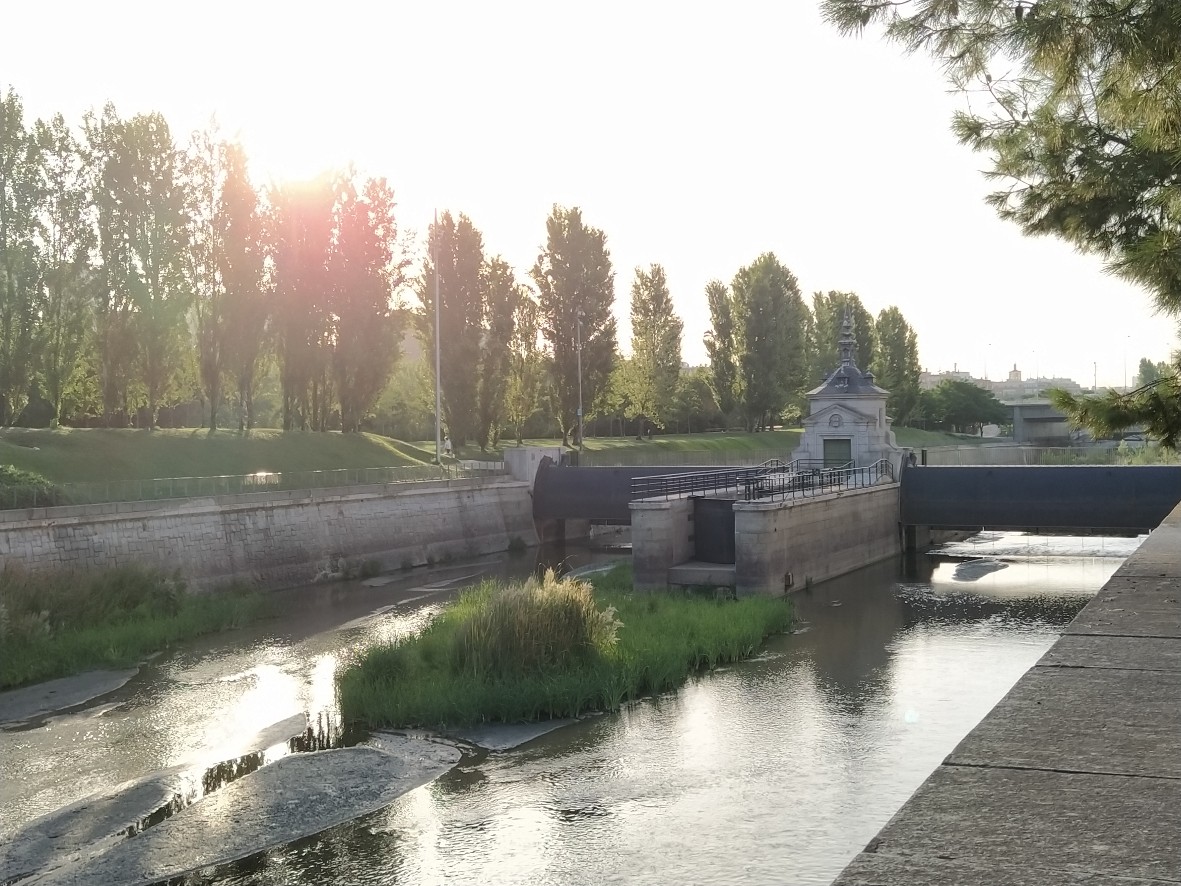
At the ecological level, margins were disconnected from the channel by artificial structures, and the longitudinal connection of flows, sediments and species between upper and lower sections virtually disappeared. As part of the Renaturalization initiative by the Madrid City Council, the urban dam gates were opened at the beginning of 2016, with the following effects: (i) water depths have lowered, on average, from 4 m to 0.3 m, (ii) water flow presents different velocities within the channel, (iii) sands are being deposited in the channelized section in the form of bars and islands, and (iv) vegetation and fauna is colonizing the new habitats.
The present study aims at evaluating this initial natural dynamics recovery through biogeomorphic metrics that allow for the association of better natural habitat conditions with the recovery of natural in-channel vegetation and fish fauna. Results show that there has been a remarkable increase in number, area and shoreline length of islands and bars straight after the gate opening (spring 2016) and a few months later (autumn 2016).
The rapid creation of bars and islands entails an increase in natural zones of terrestrial/aquatic transition (shoreline length) that can be temporarily colonized by different types of animals and plants. In this regard, surveys on fish fauna have shown an increase in the number and biomass of autochtonous species (mainly barbel), at the expense of alochtonous species (especially catfish). This case study of the Manzanares River shows how an urban river can evolve with a non-intensive intervention focused on self-forming dynamics recovery.
.Download: Biogeomorphic effects renaturalization Manzanares River